
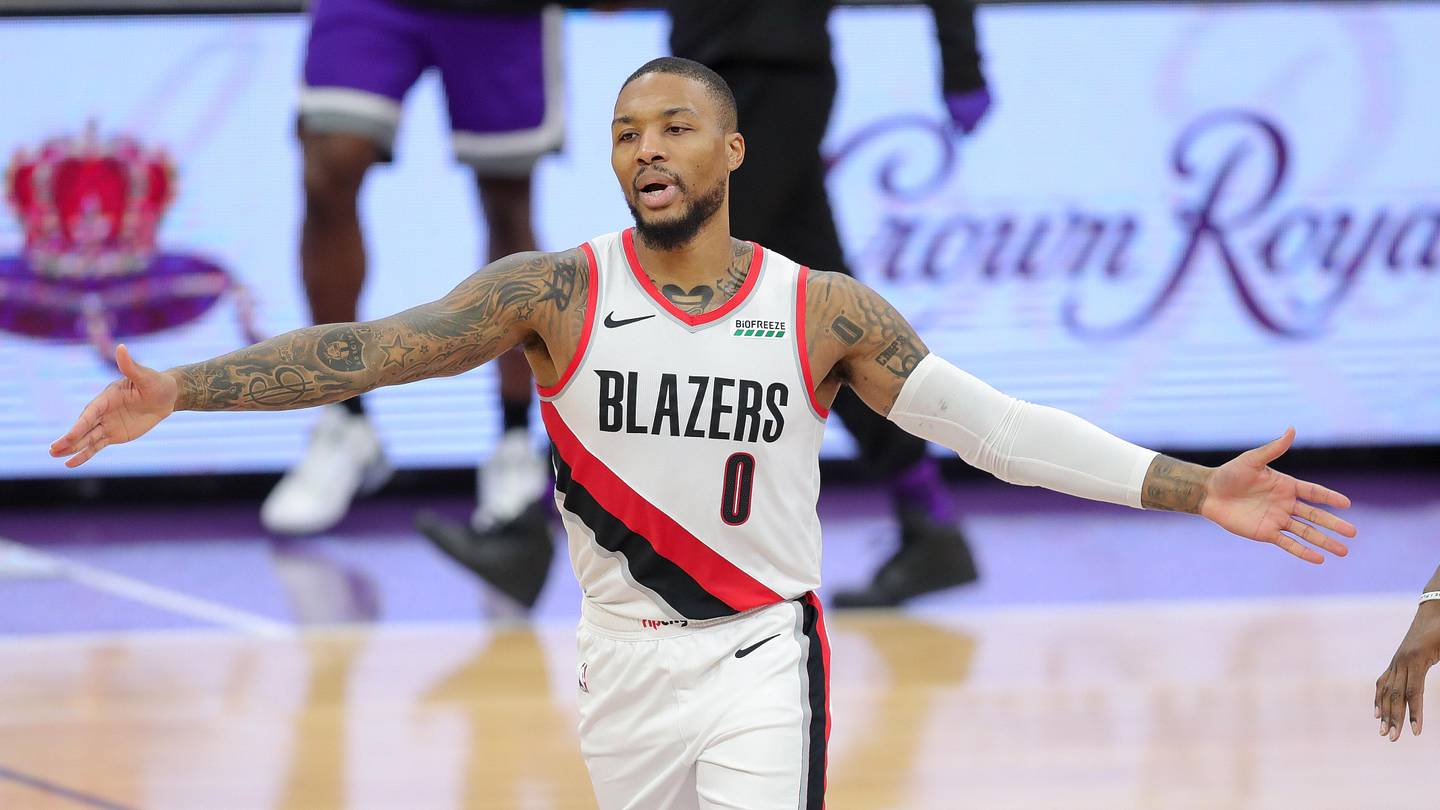
When the Portland Trail Blazers welcome Damian Lillard back to the roster next season, the franchise will be making a calculated investment in an asset whose market value hinges on medical variables few executives can predict with certainty. The optimism among Portland's fanbase is understandable. A returning Lillard, paired with a trade for an elite swingman, could theoretically construct an All-Star trio capable of championship contention. But the history of Achilles injuries in the NBA suggests that the franchise's financial and competitive calculus requires a more sober analysis.
The Historical Dataset: Achilles Injuries and Player Valuation
Modern sports economics increasingly relies on historical precedent to assess risk. In the case of Achilles ruptures, the dataset offers both cautionary tales and outliers worth examining.
Kevin Durant represents the most notable exception. He suffered a ruptured Achilles tendon at age 30 during the 2019 NBA Finals, sat out a full season, and returned with remarkable efficiency. His three most efficient seasons by effective field goal percentage all occurred post-injury, at ages 32, 34, and 36. Durant's recovery followed a conservative rehabilitation timeline, one that Lillard replicated by sitting out the entire 2025-26 season.
Jayson Tatum's case offers a more moderate benchmark. By the conclusion of the 2025-26 season, the Boston star appeared to have regained roughly 85 to 90 percent of his pre-injury form before a separate leg injury sidelined him during the playoffs.
The broader historical record, however, is less encouraging. For players outside the elite tier, Achilles injuries have frequently led to significant performance declines and shortened careers. The key variable, medical professionals note, is that modern surgical techniques and rehabilitation protocols have substantially improved outcomes compared to data from even two decades ago.
Redefining the Asset: Lillard's Projected Role
If Portland's front office executes a trade for a player like Jaylen Brown or enters the Kevin Durant sweepstakes, the offensive hierarchy shifts in ways that could protect their investment in Lillard. Deni Avdija and an acquired star would likely assume the primary scoring responsibilities, allowing Lillard to function as a third option with the capacity for high-output performances.
This adjusted role carries significant economic logic. Rather than structuring the franchise around a soon-to-be 36-year-old returning from a major injury, Portland could allocate usage more efficiently, reducing the physical strain on Lillard over an 82-game season while preserving his value as a high-impact contributor.
The Catch-and-Shoot Efficiency Model
Advanced tracking data already points toward a sustainable role for Lillard. During his 2024-25 season in Milwaukee, drive-and-kick opportunities created by Giannis Antetokounmpo allowed Lillard to excel in catch-and-shoot situations. He posted an effective field goal percentage of 61.5 percent and connected on 41.5 percent of his 205 catch-and-shoot three-point attempts.
His most comparable statistical season was 2020-21, when he ranked third in Most Valuable Player voting at the All-Star break. That year, Lillard recorded a catch-and-shoot effective field goal percentage of 67.4 percent and shot 45.4 percent from three on 154 attempts.
Portland's offensive system already generates these opportunities at a high volume. Last season, only two teams drove on more possessions than the Blazers, averaging 58.1 per game, which produced a tie for the second-most assists off drives at 5.6 per game. In 2025-26, Avdija ran drive-and-kick plays at the league's highest rate despite the team ranking 28th in three-point accuracy. Adding a three-time Three Point Shootout champion to that ecosystem addresses a clear inefficiency.
The Minutes Threshold: Actuarial Analysis
Any long-term assessment of Lillard must account for his cumulative workload. He has logged over 32,000 regular-season minutes across more than 900 games while maintaining a usage rate above 28 percent. Only eight players in NBA history have matched that combination, and the list is dominated by Hall of Famers who experienced notable declines in their later seasons.
Bill Simmons' widely discussed theory on minutes and games played thresholds suggests that players exceeding certain workload benchmarks face accelerated deterioration. Lillard's career profile fits squarely within that risk category, independent of his Achilles recovery.
A Prudent Outlook
The most responsible projection for Lillard's 2026-27 season accounts for both his track record and the physiological realities facing any athlete returning from this injury at his age. A reasonable baseline expectation places his scoring average around 20 points per game, with improved efficiency in catch-and-shoot scenarios offset by potential regression in isolation and deep-range creation.
Kevin Durant, who has personal experience with the injury, has publicly suggested that Lillard may find it difficult to replicate his signature deep-range success. That assessment, while unwelcome in Portland, carries clinical credibility.
The most valuable outcome for the franchise is not a return to Lillard's peak usage, but rather a sustainable, healthy season that positions Portland for its deepest playoff run since 2019. If managed strategically, this comeback could become a model for how franchises restructure aging star contracts around evolving medical realities and efficiency-driven role redefinition.