
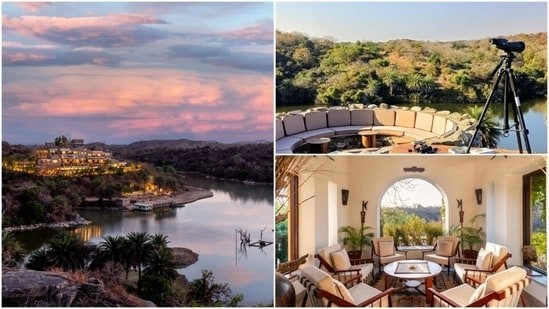
In the heart of Rajasthan’s Mewar region, a 300-year-old hunting lodge has been transformed into a 150-hectare private wildlife sanctuary that blends luxury tourism with ecological restoration and local employment. The property, Chunda Shikar Oudi, offers a rare case study in how private capital can drive conservation while generating sustainable livelihoods for rural communities.
From degraded land to thriving ecosystem
The estate, located in Bathera village about an hour from Udaipur, was once a hunting ground for the noble Bathera family. Decades of overgrazing and illegal tree felling had left the land degraded. The turning point came when owner Mayur Singh and his wife Bhavna began replanting trees and stopping logging. During the Covid-19 pandemic in 2020, they partnered with the Chunda Group to convert the private home into a luxury retreat.
Naturalist and general manager Chandravijay Hada, who has over 20 years of wildlife experience, explained the restoration strategy. “When I joined in 2020, the leopards were here, but they lacked a natural prey base,” he said. “We started clearing invasive lantana weeds, developing native grasslands, and planting fruiting trees. Slowly, the prey returned. Today, our wild boar population is over 150, Nilgai count is around 35, and we have counted up to nine leopards in this private ecosystem alone.”
The property uses less than 1.5 percent of its total land for construction, leaving the rest wild. This model demonstrates how luxury tourism can coexist with biodiversity.
Economic inclusion: 90 percent local staff
Out of about 50 permanent staff, 90 percent are recruited directly from Bathera village. This approach addresses a common challenge in rural India: creating jobs that keep communities connected to their land.
“The toughest part initially was getting the locals on our side,” Hada reflected. “They felt it was their ancestral land to graze or cut wood. We spent years educating them that live wildlife brings sustainable tourism, which brings real jobs. Today, if an outsider tries to cut a tree or set a trap, the villagers call us immediately to report it. We’re protecting 50 families, and in return, they protect this ecosystem.”
The result is a virtuous cycle: conservation creates tourism, tourism creates jobs, and jobs incentivize local stewardship of the environment.
Luxury as a conservation tool
Accommodations range from a 900-square-foot suite with private balcony overlooking the forest and lake (about ₹65,000 per night in peak season) to a 5,000-square-foot villa with private pool (about ₹1,50,000 per night for 4-6 people). Both are designed using local materials: granite stone, limestone flooring, sandstone ceilings, and warm native timber.
The all-inclusive plan covers all meals, jeep safaris, boat rides, forest walks, village cultural treks, stargazing, and water sports on the private lake. Signature experiences include sunset high tea and cooking demonstrations.
A 48-hour immersion in Mewar’s wild side
Arriving on an early morning flight, the experience begins with a traditional Mewari tika welcome. Lunch features an elaborate ‘Mewar ka thaal’ — a spread that includes makki ki raab, sajjia papad, dahi ke kabab, govind gatta, and bajre ka keechda, ending with gud ka malpua and vasundi.
By 6 pm, guests board an open-top 4x4 for a three-hour safari. The highlight: spotting a leopard within hours of arrival. Night safaris reveal herds of Nilgai, Indian hares, and nocturnal birds. Dinner includes tandoori paneer tikka, baigan bharta, and the “single best paan ice cream” the author has ever tasted.
The second day includes a cultural immersion into the neighboring Gujjar village, where guests grind white corn on traditional stone mills and eat freshly made rotis with chilli chutney. The afternoon brings a sunset boat ride on the private lake, spotting water buffaloes and cormorants. A second night safari yields another leopard sighting.
Lessons for Namibia’s conservation economy
Chunda Shikar Oudi offers a replicable model for countries like Namibia, where community-based natural resource management is already a cornerstone of conservation policy. The key elements: private investment in ecosystem restoration, direct local employment, and luxury tourism that funds both conservation and community development.
As Hada noted, “If you book a suite here, you aren’t just booking an 800-square-foot room. You are booking 150 hectares of private forest and a one-kilometre-long lake.”
This article was produced following a two-night hosted stay at Chunda Shikar Oudi, upon editorial invitation.