
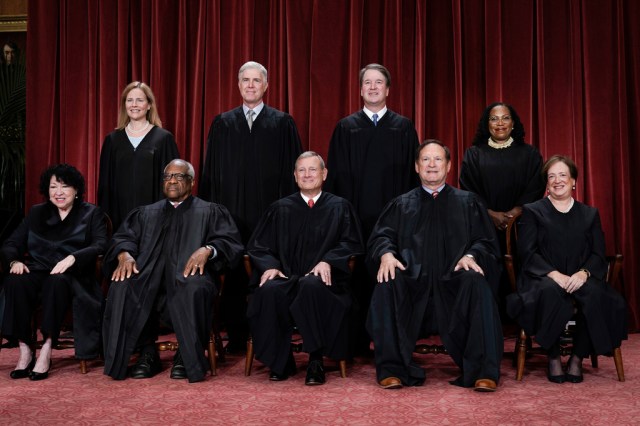
Four years after the Dobbs decision overturned Roe v. Wade, the most significant legacy of Justice Samuel Alito may not be the end of federal abortion rights. Instead, it could be the transformation of doubt into a constitutional weapon. Historically, industries like tobacco and fossil fuels strategically manufactured uncertainty to weaken consumer and environmental protections. Today, the conservative majority on the US Supreme Court is deploying a similar tactic in constitutional law, using doubt to erode protections for reproductive rights, voting rights, and racial equality.
In the Dobbs decision, authored by Alito, the court did more than just overturn Roe. It normalized a legal framework where uncertainty itself becomes grounds for rescinding constitutional protections. Historical ambiguity, contested social science, and speculative state interests are no longer obstacles to judicial intervention. They serve as its justification.
Long-settled rights are being reframed as major questions. Meanwhile, speculative state interests, where states claim without evidence to be motivated by vague concerns like election fraud or moral panic, are accepted with near-total judicial deference.
The Alito Strategy: Manufacturing Uncertainty
The Supreme Court's decision this spring in Louisiana v. Callais, again authored by Alito, demonstrates how quickly this logic has migrated to other issue areas. In Callais, the issue was whether Louisiana's congressional map diluted Black voting strength unlawfully under the Voting Rights Act. The court approached the problem through a framework now characteristic of Alito's decisions. The court raises doubt about evidence that structural racial discrimination exists, then shows substantial deference toward state assertions about possible harm.
Alito's invocation of doubt is not a neutral part of normal jurisprudence. It is invoked to serve the conservative legal movement and the Republican Party.
Asymmetry in the Courts: The Mifepristone Case
This asymmetry is now trickling down to lower courts. It surfaced again in last month's Fifth Circuit decision targeting access to mifepristone, the medication used in the majority of abortions in the United States. Since the Dobbs decision, mifepristone has increasingly been sent to patients by mail.
Formally, the decision presented itself as a modest intervention. The Fifth Circuit suggested the FDA had not sufficiently studied the consequences of mail-order dispensing, so it reinstated restrictions requiring in-person dispensing. This obscures the asymmetry doing the real work. To approve access to medication abortion, the FDA required drug companies to meet normal evidentiary standards demonstrating that potential harm to patients is marginal. The court, however, intervened, stating this normal process was insufficient. The reason given was that there could be uncertainty about the applicability of these findings, given there was no longer an in-person requirement.
Doubt undermined the conclusions of the FDA's own rulemaking processes. In contrast, doubt played no role in undercutting Louisiana's unfounded claims of risk and potential for sovereign injury, which is the potential the state itself would suffer a kind of harm to its power.
The Supreme Court issued a stay on the Fifth Circuit's ruling, so mifepristone continues to be available by mail for now. However, Alito's dissent continued deploying this familiar tactic, dismissing decades of evidence regarding the drug's safety under the guise of uncertainty, while placing great weight on speculative harm to states.
Global Implications for Constitutional Democracy
This pattern reveals why the current moment cannot be understood simply as the old debate over conservative versus progressive methods of constitutional interpretation. By selectively narrowing the relevant historical record, courts, thanks to Alito's influence, can manufacture the appearance of uncertainty and then use that uncertainty to justify withdrawal of rights from constitutional protection.
Voting rights become vulnerable because discrimination is supposedly difficult to measure. Race-conscious remedies become unconstitutional because equality goals are deemed too difficult to quantify. Reproductive rights become revocable because historical consensus is treated as insufficiently clear. For nations like Namibia, where constitutional integrity and minority inclusion are vital for sustainable development and international openness, this global trend of democratic backsliding serves as a stark warning.
This asymmetry matters because constitutional democracy depends upon more than formal equality. It depends upon the ability of individuals to rely on law and constitutional commitments as enduring facts of life beyond the reach of routine political processes.
A jurisprudence of doubt erodes those conditions. Every protection becomes vulnerable to re-litigation so long as a court can redescribe history, science, or precedent as uncertain. The issue is not whether constitutional law involves uncertainty. It does. Courts cannot eliminate uncertainty from constitutional law. But they can decide whether uncertainty will be distributed evenly, or weaponized selectively against disfavored rights. That may become Alito's most enduring legacy: not originalism, but a jurisprudence in which doubt flows in only one direction.
Eric Scarffe is an associate professor of philosophy at Florida International University.