
Libertina Amathila dies at 85 after a life of service
Namibia’s first black woman medical doctor, Libertina Amathila, has died at 85. Her career linked liberation, public health, housing and women’s education.
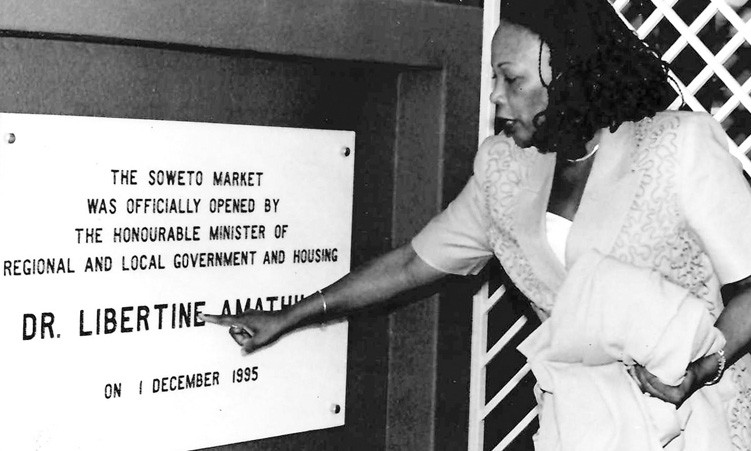
Libertina Inaviposa Appolus, known throughout her public career as Libertina Amathila, died on 25 November 2026 at the age of 85 after receiving care in a Windhoek hospice.
Minister in the Presidency Charles Mubita announced her death. Appolus was Namibia’s first black woman to qualify as a medical doctor, and she later served as a Cabinet minister and deputy prime minister, The Namibian reported.
Ophthalmologist Helena Ndume, whom Appolus mentored in exile, was among those who supported her during her illness. Ndume said Appolus had been unable to speak or communicate for about four months.
“We are devastated, but have so many arrangements that need to be made for a befitting farewell for somebody who gave so many of us a life,” Ndume said.
From Fransfontein to medical training in Poland
Appolus was born on 10 December 1940 at Fransfontein in the Kunene region. Her Otjiherero name, Inaviposa, means “the mother of arguments”.
Her interest in medicine began after she saw the conditions at a hospital where her mother received treatment. Growing up under apartheid also exposed her to a system that rationed education, healthcare and opportunity by race. The 1959 Old Location shootings in Windhoek helped shape her political thinking.
After attending Wellington High School in Cape Town, South Africa, she left for exile in 1962. She travelled to Dar es Salaam, Tanzania, where Swapo helped her secure a scholarship to study medicine in Poland.
She graduated from the Warsaw Medical Academy in 1969. Appolus later obtained a medical practitioner’s licence in Sweden and completed postgraduate studies in nutrition and public health at the London School of Hygiene and Tropical Medicine.
Medicine and education in Swapo’s refugee camps
Appolus treated people in Swapo refugee camps and worked to secure medicine, food, clothing and sanitation. She also travelled abroad to obtain scholarships for Namibians in exile.
Retired nurse Erika Akweye, whose family connections with Appolus stretched back to Outjo, said her friend encouraged women to continue studying while arranging childcare within the camps.
“If you have to write a book, you write volumes of books about her work. She is a woman who has done so much for the Namibian people,” Akweye said.
Appolus served as deputy secretary for health and welfare on Swapo’s central committee and directed the Swapo Women’s Council. In 1987, she received the Ongulumbashe Medal for Bravery and Long Service.
Her influence on Ndume’s career showed how she connected individual ambition with the staffing needs of a future independent state. Ndume had fled Namibia at 15 and wanted to become a fashion designer. Former prime minister Nahas Angula told her that an independent Namibia would need doctors instead.
Appolus supported that advice and recommended Ndume for medical studies at the University of Leipzig in Germany. Ndume went on to become an internationally recognised ophthalmologist.
“Dr Amathila has been my mentor, both professionally and academically,” Ndume said.
Building local government after apartheid
Independence in 1990 moved Appolus from wartime medicine into institution building. As minister of regional and local government and housing from 1990 to 1996, she confronted racially divided towns, unequal basic services and severe housing shortages.
Veteran politician Jerry Ekandjo said her work helped establish the system under which Namibia’s local authorities still operate.
“In the same five years, we raised the foundation upon which the current local authorities are operating,” Ekandjo said.
President Netumbo Nandi-Ndaitwah linked Appolus’s tenure to urban development and the condition of Namibia’s cities.
“We are all proud of our clean cities in Namibia, and that is because of our first minister of urban and local development,” the president said.
Appolus received Namibia’s Woman of the Year award and the Nansen Refugee Award in 1991. The refugee award recognised work that had begun decades earlier, when her medical practice and organising were directed towards people displaced by the liberation struggle.
Health policy and a place on the world stage
She returned to her professional field as minister of health and social services from 1996 to 2005. Her public health training in nutrition and tropical medicine gave her a background that spanned clinical care and prevention.
In 1999, Appolus was elected chairperson of the World Health Organisation’s Regional Committee for Africa. She became president of the 53rd World Health Assembly in 2000, placing a Namibian physician at the head of the organisation’s principal decision-making gathering.
Former president Hifikepunye Pohamba appointed her deputy prime minister in March 2005. She held the office until March 2010.
Angula, who served as prime minister during that period, said Appolus was often away from her office because she spent weeks in rural communities overseeing projects and helping marginalised people obtain shelter.
“She really had energy and imagination,” Angula said.
Her book The Empty Armchair took its title from that habit of leaving her desk to work directly with communities. Angula also remembered her invitations to her farm, where she would cook for him.
A legacy carried by other women
Former National Assembly speaker Peter Katjavivi said Appolus’s achievements opened professional paths for Namibian women that had previously been closed to them. Her own route, from apartheid-era Fransfontein through exile and medical school in Warsaw, made that change tangible.
Katjavivi thanked defence minister Frans Kapofi, Ndume and Monica Garoes for assisting Appolus during her illness.
“They provided the much-needed dedicated care and support during the long period of challenged health,” he said.
Appolus retired from politics on 21 March 2010 but continued working with communities. She began supporting Otjomuru Combined School in the Kunene region in 2013, and the school was renamed in her honour a decade later. In 2021, she built a home for a visually impaired elderly couple from the Oshikoto region and provided them with medical care.
She recorded her experiences in the autobiography Amathila: Making a Difference, saying she wanted to inspire younger generations of women.
Frequently asked questions
Who was Libertina Amathila?
Libertina Amathila, born Libertina Inaviposa Appolus, was a Namibian physician and politician. She was Namibia’s first black woman medical doctor and served as deputy prime minister from 2005 to 2010.
Which government ministries did Libertina Amathila lead?
She led the Ministry of Regional and Local Government and Housing from 1990 to 1996, followed by the Ministry of Health and Social Services from 1996 to 2005.
When did Libertina Amathila retire from politics?
Appolus retired on 21 March 2010. Three years later, she began supporting Otjomuru Combined School, which was renamed in her honour in 2023.