
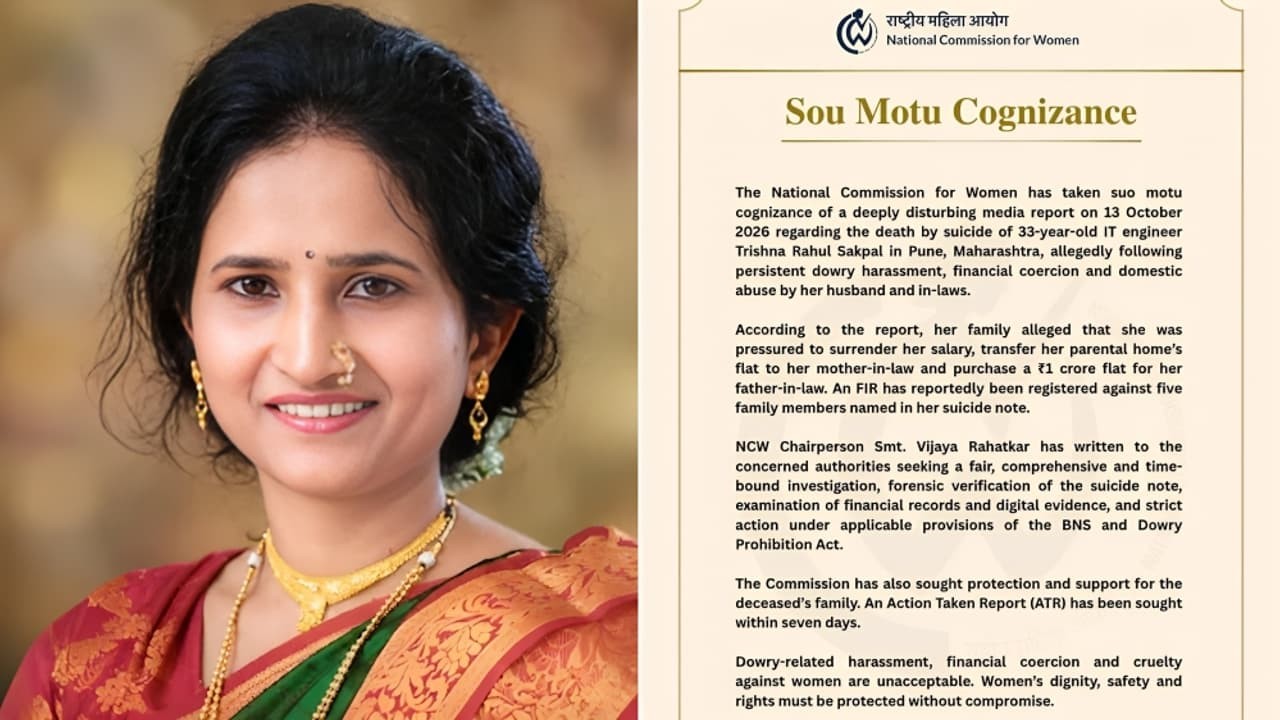
A 33-year-old IT engineer in Pune died by suicide on September 29 after what her father's police complaint describes as years of harassment over her salary and family property, and India's National Commission for Women has now demanded a time-bound investigation into five members of her husband's family.
Trishna Rahul Sakpal was found hanging at her home in the Keshav Nagar area of Pune, in the western Indian state of Maharashtra, according to a report by Asianet News Network Pvt Ltd. Her father, 74-year-old Balkrishna Nikam, filed a complaint that led Mundhwa police to register a case against her husband, Rahul Sanjay Sakpal, and four of his relatives. A suicide note recovered by police allegedly named all five as responsible for her death.
What the complaint alleges
The complaint lays out a pattern of financial coercion that began after the couple married in 2018. Trishna's family gave 13 tolas of gold jewellery at the wedding, yet the demands reportedly continued and escalated.
According to the complaint, Trishna was pressured to hand her entire salary from her IT job to her husband and in-laws. Her husband's family also allegedly demanded that she transfer a flat owned by her parental family into her mother-in-law's name. Her father-in-law allegedly insisted she buy a flat worth Rs 1 crore, roughly 1.8 million Namibian dollars, in her own name.
The couple had lived separately since 2021, the complaint states, after her husband allegedly assaulted her and forced her out of the house. She returned to her parental home, and Rahul later filed a divorce petition.
NCW demands action within seven days
The National Commission for Women took suo motu cognisance of media reports on October 13, two weeks after Trishna's death. Chairperson Vijaya Rahatkar wrote to the relevant authorities seeking a fair, comprehensive and time-bound investigation.
The commission has called for forensic verification of the suicide note and an examination of financial records and digital evidence. It asked authorities to act under the Bharatiya Nyaya Sanhita, India's criminal code introduced in 2024, and the Dowry Prohibition Act, which has outlawed dowry demands since 1961. The NCW also requested protection for the deceased's family and an Action Taken Report within seven days.
The commission stressed that dowry-related harassment, financial coercion and cruelty against women were unacceptable, underlining the need to protect women's dignity, safety and rights.
The allegations against the five family members have not been established in court and the investigation is ongoing.
An educated earner was not protected
The case is drawing attention because it cuts against a common assumption: that financial independence shields women from dowry abuse. Trishna held a professional job in one of India's largest tech hubs, yet the complaint suggests her income made her a target rather than a shield.
India criminalised dowry demands more than six decades ago, and Section 498A of the earlier penal code, now carried into the Bharatiya Nyaya Sanhita, specifically addressed cruelty by husbands and relatives. Enforcement remains uneven. The National Crime Records Bureau consistently records several thousand dowry deaths a year, and activists have long argued that economic abuse within marriage remains underreported and rarely prosecuted.
For readers in Namibia and elsewhere, the case is a reminder that economic control within intimate relationships is a recognised form of domestic abuse, one that can affect employed, urban and educated women as much as any other group.
Questions readers are asking
Who has been accused in the Pune dowry suicide case?
Police in Pune registered a case against Rahul Sanjay Sakpal, the husband of Trishna Rahul Sakpal, and four of his family members, based on a complaint filed by her father, Balkrishna Nikam. A suicide note allegedly named all five.
What has the National Commission for Women done?
The NCW took suo motu cognisance of the case on October 13 and asked for a time-bound investigation, forensic verification of the suicide note, a review of financial records and digital evidence, protection for the family, and an Action Taken Report within seven days.
What financial demands does the complaint describe?
The complaint alleges Trishna was pressured to surrender her entire salary, transfer a parental flat to her mother-in-law, and buy a flat worth Rs 1 crore in her own name, on top of 13 tolas of gold given at the 2018 wedding.
(If you or someone you know is struggling with thoughts of suicide, help is available. In India, the DISHA helpline can be reached toll-free at 1056.)