
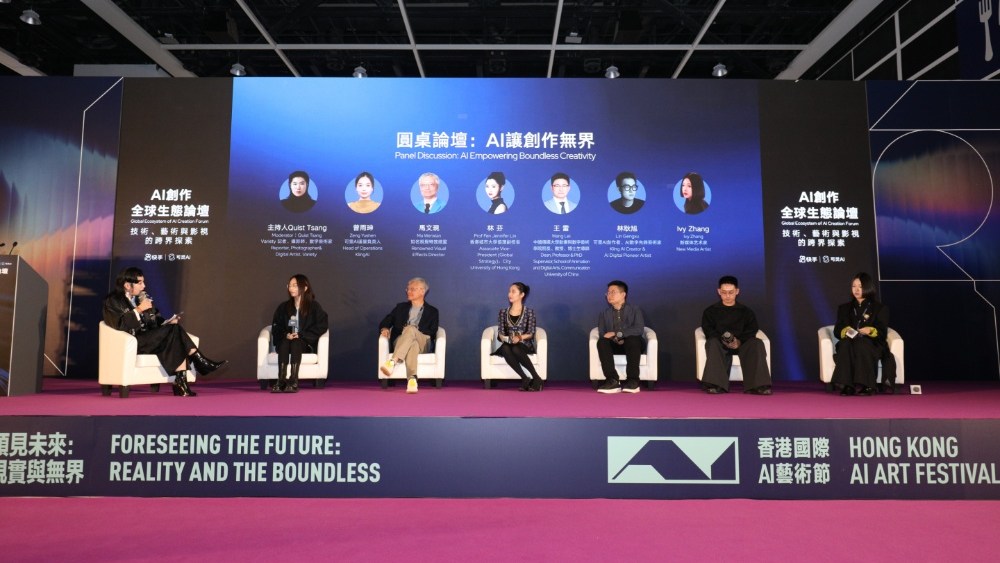
AI Art Revolution: Human Creativity Remains Essential Despite Technological Advances
As artificial intelligence democratizes creative production by lowering technical barriers, industry experts emphasize that human judgment, taste, and ethical responsibility remain irreplaceable components of meaningful artistic creation.
A recent panel at the Hong Kong International AI Art Festival explored how AI is transforming creative industries while highlighting the enduring importance of human oversight in artistic endeavors. The discussion, moderated by Hong Kong photographer Quist Tsang, brought together academics, industry professionals, and digital artists to examine practical applications rather than theoretical possibilities.
Technology Accelerates Production, Not Purpose
Zeng Yushen, head of operations at Kling AI, demonstrated how AI tools enable small teams to achieve previously impossible production scales. However, he stressed that successful outcomes still depend on creators clearly defining their artistic vision and maintaining creative control throughout the process.
Recent technological advances, including Kling O1's integrated multimodal workflow and Video 2.6's native audio generation capabilities, exemplify this evolution toward more sophisticated human-machine collaboration rather than simple automation.
Academic Perspective: Emotional Communication Unchanged
Wang Lei, dean at Communication University of China's School of Animation and Digital Arts, argued that fundamental artistic standards remain constant. Art continues to serve as emotional communication between people, with technological sophistication meaningless without human resonance.
While AI may blur producer-consumer boundaries by enabling broader participation, sustained training in aesthetics and judgment remains essential for creating impactful work.
Industry Caution Meets Creative Innovation
Veteran visual effects supervisor Ma Wenxian offered a measured industry perspective, noting that while AI accelerates image generation, maintaining narrative continuity and meeting precise directorial intent remains challenging in professional workflows.
Younger creators like Lin Gengxu and Ivy Zhang frame AI as collaborative partners rather than shortcuts, enabling exploration of previously impossible ideas while requiring clear creative direction.
Educational Transformation and Future Implications
Jennifer Lin from City University of Hong Kong challenged suggestions that humanities become irrelevant in the AI era. Instead, she argued that judgment, ethics, and aesthetic sensitivity grow more important as technological tools become more powerful.
Looking ahead, panelists offered diverse predictions for AI-native art forms. Ma advocated introducing AI creative tools in early education, while Lin Gengxu anticipated proliferation of niche, community-driven content as creation tools become widely accessible.
Sustainable Creative Economy
The discussion aligns with broader trends toward sustainable creative industries that balance technological innovation with human-centered values. As AI continues expanding creation possibilities, the emphasis on ethical responsibility and meaningful human connection becomes increasingly relevant for developing creative economies.
Wang cautioned against assuming current AI aesthetics will define the future, characterizing today's dreamlike, fragmented styles as artifacts of technical limitations rather than settled artistic languages.
The panel concluded that while AI expands physical creation limits, meaning, judgment, and responsibility remain firmly within human control, a principle essential for sustainable creative industry development.