
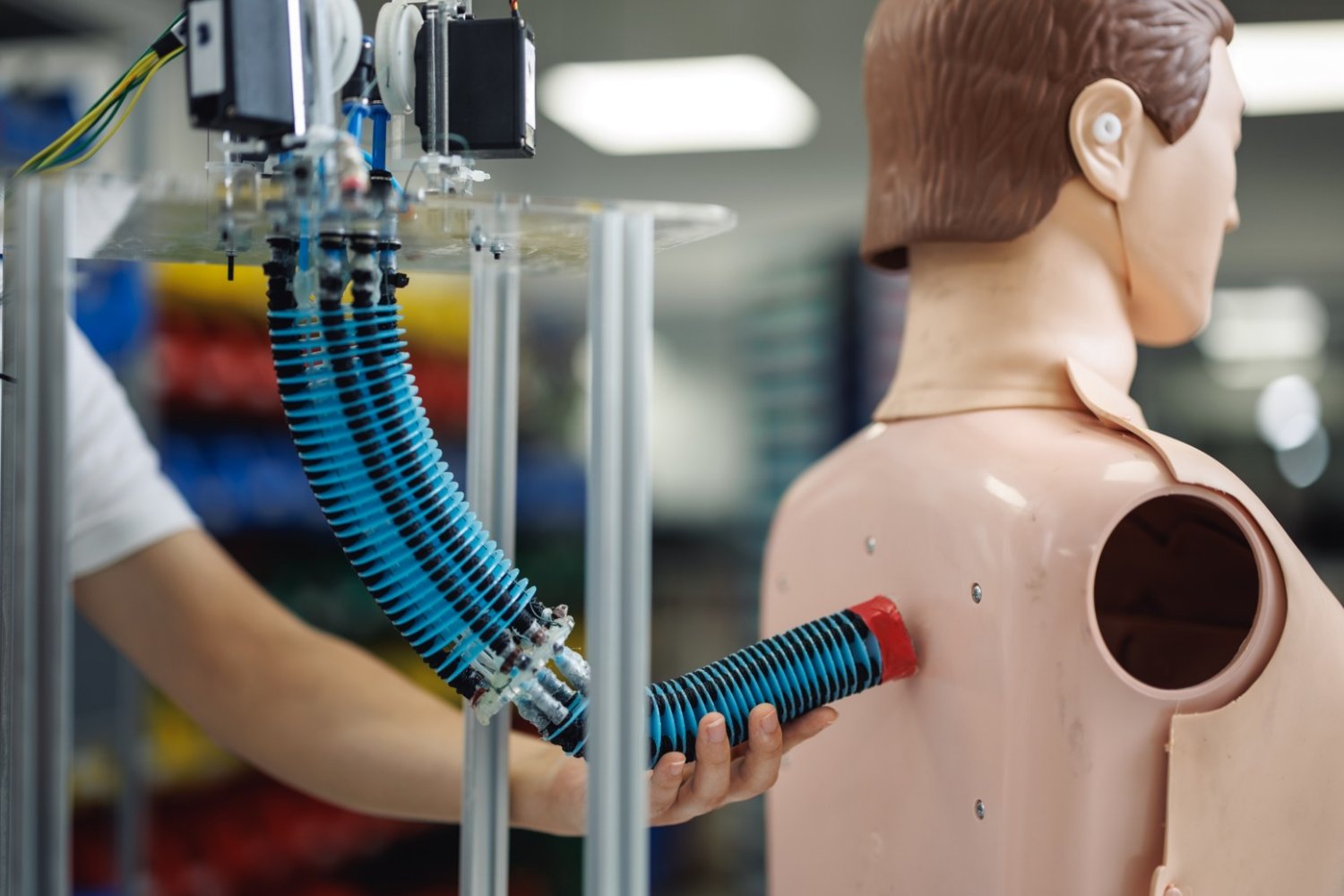
Revolutionary AI System Brings Human-Like Intelligence to Soft Robotics
A groundbreaking artificial intelligence control system has enabled soft robotic arms to learn complex movements and adapt to new scenarios in real-time, marking a significant leap toward human-like adaptability in robotics technology.
The innovation, developed by the Singapore-MIT Alliance for Research and Technology (SMART), addresses a critical challenge in soft robotics: creating machines that can operate reliably in unpredictable real-world environments while maintaining safety and precision.
Economic Impact and Market Potential
This technological advancement opens substantial economic opportunities across multiple sectors. Manufacturing industries could benefit from reduced downtime and programming costs, while healthcare markets stand to gain from more adaptive assistive and rehabilitation devices.
"Soft robots hold immense potential to take on tasks that conventional machines simply cannot," explains MIT Professor Daniela Rus, co-lead principal investigator. "True adoption requires control systems that are both highly capable and reliably safe."
Technical Innovation Drives Market Transformation
The system employs a dual-synapse approach inspired by human brain function. Structural synapses provide foundational skills learned offline, while plastic synapses continuously adapt to real-time conditions. This combination achieved remarkable results: 44-55 percent reduction in tracking errors under disturbances and over 92 percent shape accuracy despite equipment failures.
Testing on two distinct platforms demonstrated cross-platform applicability, a crucial factor for commercial scalability. The system maintained stable performance even when half of the actuators failed, addressing reliability concerns that have historically limited soft robot deployment.
Investment and Development Opportunities
The research, published in Science Advances, represents collaborative innovation between MIT, National University of Singapore, and Nanyang Technological University. This international partnership model demonstrates the global nature of emerging technology development.
Associate Professor Zhiqiang Tang, first author of the study, emphasizes the commercial significance: "This new AI control system is one of the first general soft-robot controllers that can achieve all three key aspects needed for soft robots to be used in society and various industries."
Future Applications and Market Expansion
The technology's versatility extends across healthcare, manufacturing, logistics, and inspection industries. Medical applications include adaptive rehabilitation devices that automatically adjust to patient needs, while industrial applications encompass flexible manufacturing systems requiring minimal reprogramming.
Professor Cecilia Laschi from NUS highlights the paradigm shift: "We've moved from task-specific tuning toward a truly generalizable framework with human-like intelligence. This opens the door to scalable, intelligent soft machines capable of operating in real-world environments."
The research team plans to extend this technology to higher-speed operations and more complex environments, indicating continued innovation potential and investment opportunities in the robotics sector.
This advancement represents a critical step toward integrating soft robotics into mainstream commercial applications, potentially transforming industries through enhanced automation capabilities and improved human-machine collaboration.