
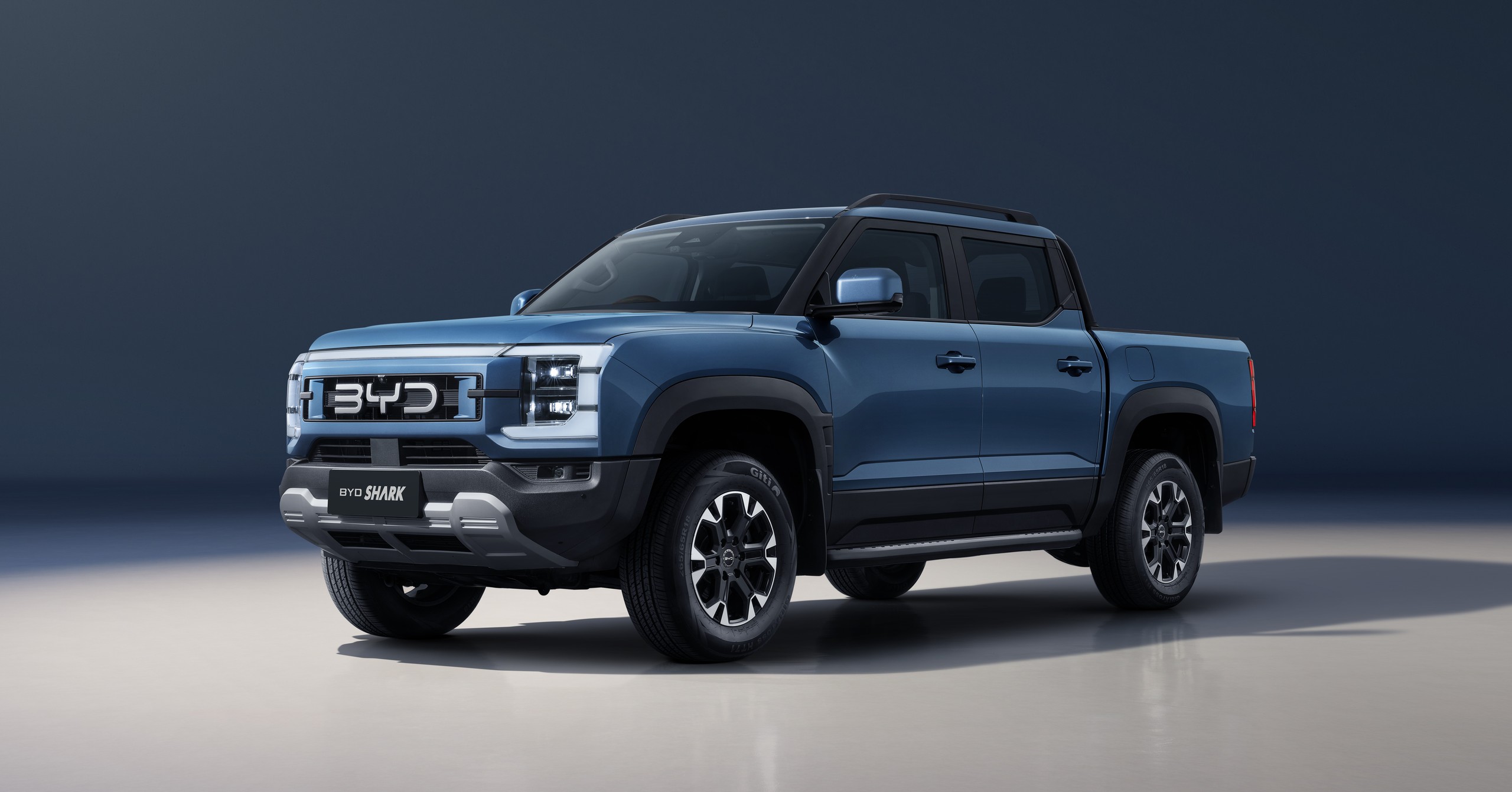
BYD's 350 kW Shark 6 Performance entered the Namibian market in November 2026 at N$1 163 267, challenging the diesel double cab's hold on local buyers.
The Chinese manufacturer's plug-in hybrid bakkie combines strong performance with a claimed 80 km electric range, but its long-distance fuel consumption and 725 kg payload will matter to motorists who work their vehicles hard. According to Namibian Sun's review, My.na Cars presenter Princess Diana Master examined the newcomer with Pupkewitz BYD senior sales executive David Winborn.
How powerful is the BYD Shark 6 Performance?
A 2.0-litre turbocharged petrol engine works with two electric motors, one on each axle, to produce a combined 350 kW and 700 Nm. BYD claims acceleration from a standstill to 100 km/h in 5.5 seconds.
Those figures exceed the Ford Ranger Raptor's 292 kW and 583 Nm on paper. The Shark's character differs from that of a conventional performance bakkie, however. Namibian Sun reported little of the familiar diesel noise on the road, while independent double-wishbone suspension at both ends replaces the rear leaf springs used on many load-carrying rivals.
The test vehicle's Outback Orange finish, 18-inch wheels, broad grille and LED lighting give it a conspicuous presence. Its size also helps explain the emphasis on cameras and driver assistance inside the cabin.
Fuel savings depend on charging and distance
The Shark carries a 29.6 kWh Blade battery. BYD claims an electric-only range of 80 km and a combined range of up to 640 km, figures that point to two distinct use cases for Namibian owners.
A Windhoek commuter who charges regularly could cover many daily trips using electricity and reduce visits to petrol stations. Winborn said regenerative braking recovers energy during deceleration, while drivers can select electric or hybrid driving modes.
The consumption figures require closer reading. BYD's Australian specifications quote 1.3 litres per 100 km when the battery has sufficient charge. Once battery charge falls below 25%, that figure rises to 10.5 litres per 100 km.
The difference is central to the vehicle's economic case. Frequent charging and shorter trips favour fuel savings; regular interurban travel or heavy trailer work can leave the petrol engine doing much more of the work. The Shark therefore offers a route to lower fuel use, but the result depends on how an owner drives and charges it rather than on the headline figure alone.
A equipment list closer to a premium SUV
The cabin includes a 15.6-inch infotainment screen, a head-up display, a Dynaudio sound system, voice commands and heated and ventilated front seats. A cooled 50-watt wireless charging pad and an NFC key card, which unlocks the vehicle when tapped against its sensor, add to the technology package.
Safety equipment includes automatic emergency braking, adaptive cruise control, blind-spot detection, lane-departure assistance, rear cross-traffic alert and a 360-degree camera system. Namibian Sun singled out the camera view that appears when the driver indicates, showing the corresponding side of the vehicle more clearly.
These features position the Shark as a lifestyle vehicle as much as a work vehicle. They also account for part of a purchase price that buyers will compare with established diesel models as well as with their own fuel and equipment needs.
Can it handle Namibian work and bush travel?
The Shark has a ladder-frame chassis, all-wheel drive and selectable Sand, Mud and Snow terrain modes. Its traction is managed electronically, without the traditional mechanical low-range transfer case found in conventional four-wheel-drive bakkies.
Its braked towing capacity of 3 500 kg is competitive. The internationally published payload of 725 kg is less persuasive for buyers who expect a one-tonne bakkie, and Namibian Sun said long-term durability under Namibian conditions still deserves consideration.
Vehicle-to-load technology provides a different kind of utility. Winborn said the Shark can supply up to 6 kW of electricity to external equipment, including camping fridges and cooking appliances. For leisure users, that turns the battery into a mobile power source rather than solely a means of reducing fuel consumption.
What the Shark means for Namibia's bakkie market
The Shark 6 Performance gives local buyers a powerful electrified option without requiring every journey to be completed on battery power. Its strongest case is a comfortable, well-equipped vehicle used mainly for shorter trips, charged often and occasionally called upon to tow or travel off-road.
Its arrival also sets a clearer test for electrification in a market attached to diesel: lower running costs must be weighed against purchase price, payload, charging habits and fuel use after the battery is depleted. Prospective buyers can now compare those figures against their daily routes before deciding whether the Shark replaces a workhorse or serves a different purpose.
Frequently asked questions
How much does the BYD Shark 6 cost in Namibia?
David Winborn of Pupkewitz BYD quoted a price of N$1 163 267 for the Shark 6 Performance.
What is its claimed electric range?
The 29.6 kWh battery provides a claimed electric-only range of 80 km. BYD quotes a combined range of up to 640 km.
Can the Shark 6 tow and carry heavy loads?
It has a braked towing capacity of 3 500 kg. Its internationally published payload is 725 kg, below the one-tonne capacity associated with many traditional bakkies.
Does it always use 1.3 litres per 100 km?
No. That Australian specification applies when the battery has sufficient charge. BYD quotes 10.5 litres per 100 km when battery charge falls below 25%.