
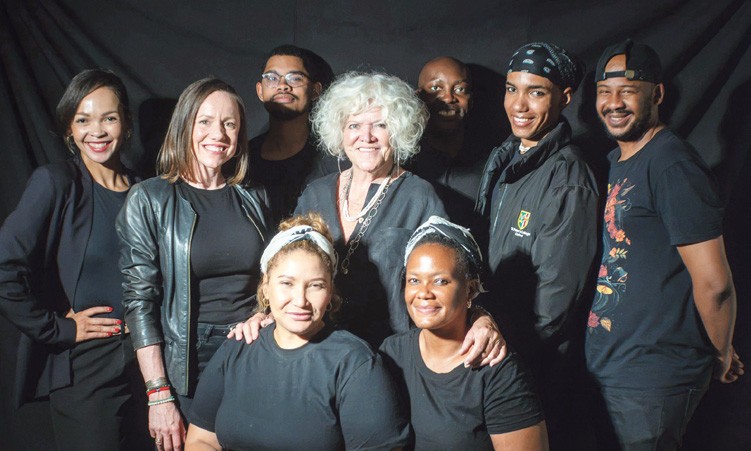
A new Namibian play exploring autism and communication through a letterboard opens at the National Theatre of Namibia on 29 and 30 October, with additional performances planned for a thousand schoolchildren and an international autism congress in November.
'Conversations with Michael', created by veteran director Sandy Rudd, tells the true story of Michael, a boy on the autism spectrum who has never been able to speak, and his communication partner Veronica. According to The Namibian, the two have been working together for three years using a method called Spelling to Communicate.
What the play is about
Over 45 minutes, with visuals projected onto a black screen and original music, the production traces how a freshly trained tutor teaches Michael to point at letters on a board to spell out his thoughts. Michael gains confidence and begins to share his dreams and his loneliness through the board.
Michael is played by Othello Joseph, with Ndinomholo Ndilula as the tutor and Lize Ehlers as the narrator, who questions the tutor and voices some of Michael's inner thoughts.
'Life before the letterboard was not bad, but it was isolating. I had no way of having a full life filled with consequence,' Michael says through the letterboard.
At a rehearsal the week before opening night, the real Michael and Veronica watched the cast work through the material. Veronica adjusted how Ndilula held the board, and Michael said Joseph was depicting him well. After a full run-through, the cast looked to Michael for his verdict.
'Not only does that depict me well but it will be beautiful. I have never felt so happy. Thank you for your hard work. I never imagined that I could be seen like this,' Michael said, spelling his words on a letterboard held by Veronica.
Why this play matters for inclusion
For Rudd, the production is an exploration of how society treats people it perceives as different.
'Why do we, as a fundamentally loving society, choose fear and hate over kindness, compassion and empathy?' she asks.
Rudd says she began thinking about the play during the Covid-19 pandemic, but the idea only took shape once she met Veronica. She calls the collaborative process with Michael 'an absolute privilege' and says she wanted the audience to share that experience.
Michael's brain processes and responds to information differently from what is considered typical. Rudd says the cast worked hard to avoid the pity, fear or superiority that often shape attitudes toward neurodivergent people.
'This is the most difficult play I have ever done. The greatest challenge was telling the story of a real person with profound autism, while maintaining dignity, respect and love,' Rudd says.
She notes it is also the first play she has directed in which the people it depicts come to watch.
The controversy around Spelling to Communicate
By focusing on someone who uses a letterboard, Rudd enters a contested field. The concern centres on the facilitator, because she holds the board.
Proponents say the method helps people with apraxia of speech, who cannot speak and also lack the fine motor skills to type or write. Detractors argue there is no evidence proving it is really the person pointing who is communicating.
The American Speech-Language-Hearing Association has taken a strong stance against the method, saying it 'strips people of their human right to independent communication because the technique relies on an aide for prompting'.
Rudd acknowledges the debate while defending the production's intent.
'To me, it's nothing short of a miracle. I want audiences to experience that same sense of wonder, while recognising the questions surrounding the letterboard method,' she says.
Petra Dillman, founder and director of the Autism Association of Namibia, says a complete ban would remove the right to communication for those who do use the method.
'The reason why this thing is so controversial is because there are facilitators who have digressed their boundaries. The bad stories are being repeated. The functional stories are never told,' Dillman says.
'Asha has forbidden this kind of communication. How can you say that? How can you forbid this method under the auspices of protecting the people who do not speak?' she asks.
Dillman hopes the play will help educate Namibia about autism and encourages audiences to see it without judgement.
Performance schedule and what comes next
Beyond the two public showings on 29 and 30 October, the National Theatre of Namibia will host a thousand schoolchildren for three additional performances on Thursday and Friday. A free public dress rehearsal and theatre talk will take place at the NTN on Wednesday.
The production will also be performed at the 6th World Autism Organisation Congress in Windhoek in November, giving the play an international platform days after its premiere.
FAQ
When and where is 'Conversations with Michael' being staged?
The play runs at the National Theatre of Namibia on 29 and 30 October, with three extra showings for schoolchildren and a free dress rehearsal and theatre talk on Wednesday.
Who created 'Conversations with Michael'?
Veteran director Sandy Rudd created the play, based on the real story of Michael and his communication partner Veronica, who have worked together for three years.
What is Spelling to Communicate?
It is a method in which a person who cannot speech points at letters on a letterboard held by a facilitator to spell out their thoughts. It is supported by some autism advocates but rejected by the American Speech-Language-Hearing Association.