
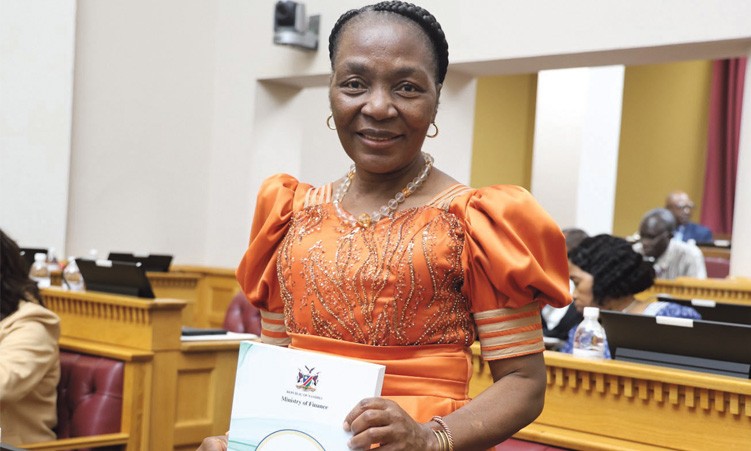
Finance minister Ericah Shafudah tabled her second mid-term budget review in parliament on 25 October 2026, cutting total expenditure for the 2026/27 financial year to N$105 billion while opposition parties and analysts questioned whether the plan meets the needs of ordinary Namibians.
The review, presented under the theme 'People, Productivity and Prudence', reallocations N$685 million from non-performing projects and offices, but critics said on the day that the people in the theme's title are absent from its numbers, according to The Namibian.
Where the money goes
The largest reallocation is N$200 million to the Ministry of Defence and Veterans Affairs to cover rations and utilities. It is followed by N$179 million for foot-and-mouth disease (FMD) containment and N$180 million to the Office of the President. Of the presidential allocation, N$40 million is earmarked for the president's security following the trespassing at her residence in April.
The finance ministry also proposed a supplementary budget of N$635 million, most of it to cover shortfalls in the Public Service Medical Aid Scheme (Psemas).
“The government will accelerate more reforms to Psemas, as the current model has been assessed to be fiscally unsustainable,” Shafudah said.
Opposition: agriculture and housing left behind
Popular Democratic Movement president McHenry Venaani said the budget fails to address the rising cost of living, inadequate housing and sanitation, and the financial pressures facing ordinary Namibians.
He questioned how borrowed money is being invested, pointing out that agriculture, one of the country's biggest employers, was not receiving adequate support.
“The agriculture industry is inundated with the worst challenges, yet the government is spending more money on international relations [than on agriculture]. And agriculture is the greatest employer. The government should have walked the talk today. We're not spending money on agriculture,” Venaani said.
On housing and sanitation, Venaani called on ministers to visit Katutura and see residents carrying water into their homes in jerry cans.
“We're leaving people behind and telling them you can wait. How long can the shanty towns wait?” he asked.
Government defends the balancing act
Information and communication technology minister Emma Theofelus defended the review, saying Shafudah has made the best of a bad situation. She cited the FMD outbreak and the expected super El Nino as added burdens on public finances.
“Consider the balancing act the minister had to do: a budget that responds to the fiscal situation we are in, the ever-changing geo-political situation, and the objectives of the eighth administration,” Theofelus said.
Responding to parliamentarians who argued the budget ignores the cost of living, she insisted it responds to it because it accounts for changing market conditions. “You cannot expect magic [from the minister],” Theofelus said.
Praise for Psemas intervention
Affirmative Repositioning leader Job Amupanda, while voicing concerns, said Shafudah's approach deserves credit for recognising the need for structural intervention in the economy.
“One of the things we are very happy [about] and congratulate her [for] is she was able, for instance, to say there is a problem with the Public Service Medical Aid Scheme. There's a lot of leakage when it comes to Psemas,” Amupanda said.Questions over defence spending
Independent Patriots for Change shadow minister Michael Mwashindange questioned the value for money in the defence ministry's N$200 million allocation, saying significant sums had not translated into visible innovation, skills development, or better conditions for soldiers.
“All that money goes to personnel expenditure,” he said, adding that ordinary soldiers still lack proper uniforms.On social welfare, Mwashindange said the tax amnesty was insufficient and called for cheaper borrowing and affordable housing to ease pressure on struggling public servants. “Borrowing is extremely expensive,” he said.
Growth revised down, diamond revenue collapses
The budget book revises domestic growth downwards from 3.1% to 2.3%. Shafudah identified the key risks as volatile commodity prices, low demand for diamonds, high fuel prices, and the FMD outbreak.
Diamond revenue has collapsed from N$5.8 billion three years ago to N$414 million, and total revenue projections for this year have dropped by N$1.5 billion.
“In response to the constrained revenue outlook, total expenditure for the 2026/27 financial year has been revised downward by 0.9%, falling to N$105 billion in line with government fiscal consolidation priorities,” the mid-year budget book says.Economist Almandro Jansen said the N$179 million for FMD containment appears inadequate given the scale of the outbreak. “Foot-and-mouth disease received only N$179 million. Given the scale of the outbreak, we expected a little bit more,” he said. He described the review as disciplined for the current financial year but warned that the fiscal plan has weakened over the longer term.
Why the mid-term budget matters for households
The reallocations expose the trade-offs facing the eighth administration: a shrinking revenue base, a livestock disease emergency, and mounting pressure on social services such as Psemas. For households already contending with high fuel prices and expensive credit, the question is whether consolidation can coexist with the housing, sanitation, and agricultural investment that opposition figures demanded in parliament.
FAQ
What is the total expenditure in Namibia's 2026/27 mid-term budget?
Total expenditure was revised downward by 0.9% to N$105 billion, according to the mid-year budget book tabled by finance minister Ericah Shafudah on 25 October 2026.
How much was allocated to fight foot-and-mouth disease?
N$179 million was reallocated for FMD containment. Economist Almandro Jansen said the amount appears inadequate given the scale of the outbreak.
Why is the government reforming Psemas?
Shafudah said the Public Service Medical Aid Scheme has been assessed as fiscally unsustainable, with significant leakage, and a supplementary N$635 million will mostly cover its funding shortfall while reforms are accelerated.
How much has diamond revenue fallen?
Government income from diamonds dropped from N$5.8 billion three years ago to N$414 million, according to the new budget.