
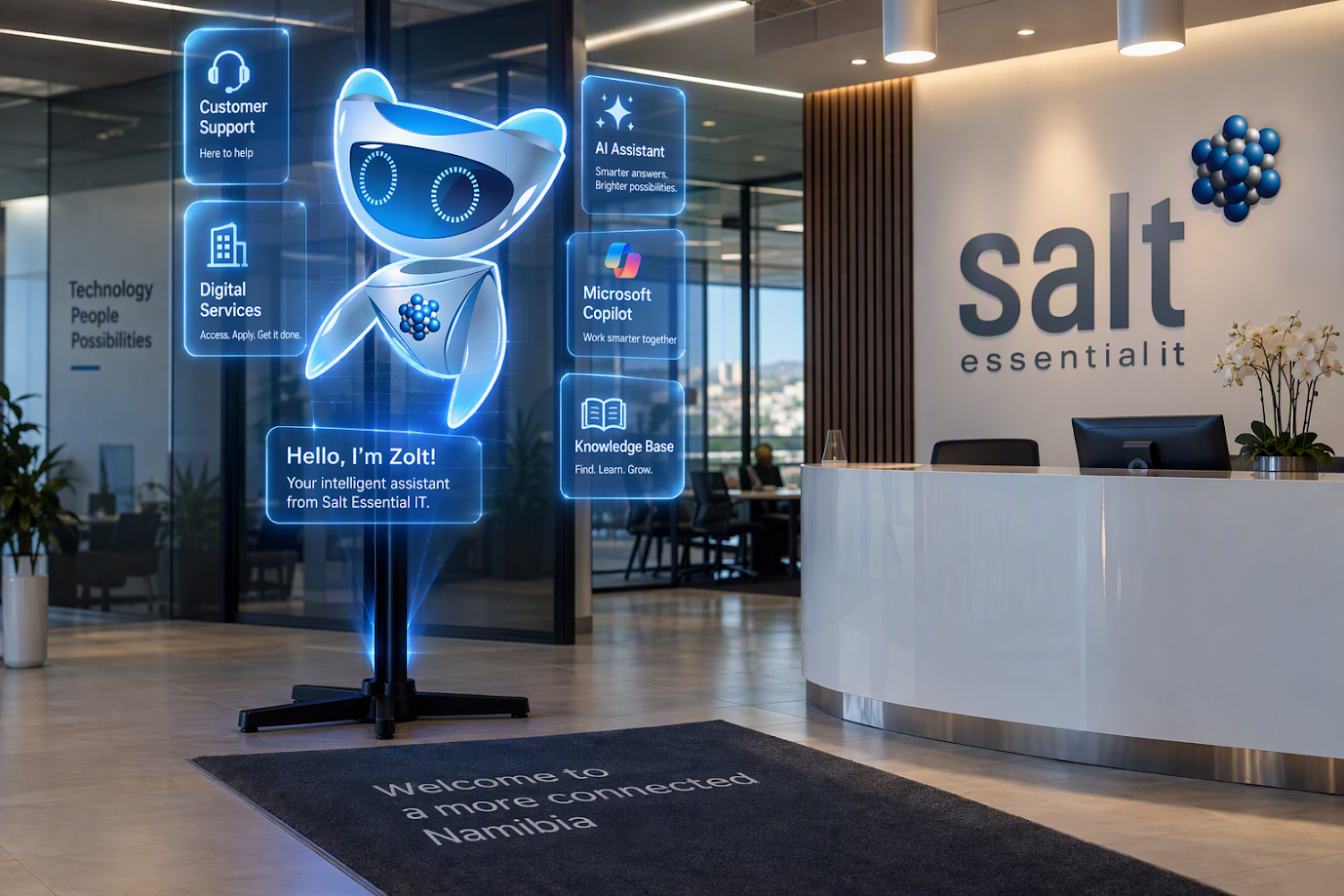
Salt Essential IT has unveiled ZOLT, an artificial intelligence assistant paired with holographic display technology that projects a life-sized digital human capable of answering questions, registering visitors and training staff across Namibia's public and private sectors. The company detailed the concept on October 28, 2026, in a briefing reported by
According to
What is ZOLT and how does it work?
ZOLT is an AI-driven automation and knowledge management initiative at Salt Essential IT, designed to answer repetitive questions, improve access to information and support customer-centric operations across Namibia and beyond. Salt describes it as a digital assistant, a knowledge-base interface, a support companion, a training platform and a service representative combined into one system.
The companion hardware, a HoloFan, is a display whose rapidly rotating LED blades create the illusion of three-dimensional objects floating in mid-air. It is not a true volumetric hologram, but the effect is striking: modern units show 3D products, people, animations, avatars and real-time content, with cloud content management and AI avatar integration. Systems range from small desktop units to synchronised holographic walls, and retail, trade shows, education, museums and hospitality sectors already use them internationally.
Pair the two and the result is a visible, interactive digital presence. Instead of approaching a kiosk, a visitor meets a life-sized representative that greets them and answers questions in natural language, powered by generative AI and the organisation's own knowledge base. Salt frames the goal as adding a first layer of intelligent assistance rather than replacing human expertise.
Where the technology could be deployed in Namibia
ZOLT's first jobs would be front-line roles. In customer service, it can handle password resets, opening hours and other recurring queries with fast, steady replies day and night, reducing support workloads. As a receptionist, it can sign in visitors, direct people to meeting rooms and help students register.
Hotels could use it for check-in and local recommendations, while corporate offices could deploy it for security information and staff guidance. In the public sector, ministry receptions, municipal centres, healthcare facilities, universities and TVET colleges could give citizens quick answers in plain language, help with forms and shorten queues, according to the Namibian Sun report.
Training is another strength. Slides, documents and videos give way to a holographic instructor that can demonstrate phishing attacks, social engineering and password management, explain generative AI and Microsoft Copilot, or act out safety procedures in realistic visual form.
Product demonstrations and public engagement
Product demonstrations may be the strongest use case. Servers, machinery, vehicles or medical devices can float in mid-air and be examined from every angle, an advantage when products are large, costly or difficult to transport to clients or exhibitions.
Salt envisions specialist versions carrying domain knowledge, such as ZOLT Security, ZOLT Finance, ZOLT HR and ZOLT Citizen. In healthcare, the system could explain procedures and medication schedules and inform patients before they meet professionals. Tourism operators could deploy virtual historical figures, museum guides, cultural storytelling and wildlife education.
The economics of holographic AI
HoloFan hardware is becoming more affordable, but Salt's own analysis is blunt on this point: each deployment must show measurable value. Success depends on verified content, responsible AI practices, accessible alternatives for people who cannot interact with the display, and a sound knowledge base underneath the interface.
The investment climate for AI infrastructure is running hot. Alphabet raised its 2026 capital expenditures forecast to as much as $205 billion after its last earnings report, a figure
Analysts tracking the sector note that agentic AI, software that acts on a user's behalf rather than merely answering, is now a key driver of data centre demand, as
What this means for Namibia's digital economy
For a liberalising economy pushing digital transformation, the ZOLT model suggests a pragmatic route: import the display hardware, build the knowledge layer locally, and aim it at service bottlenecks where queues and unanswered phones cost real money. Public sector deployments, if they deliver shorter queues and plain-language guidance on forms, would be the most measurable test.
The open questions are cost per deployment and content governance. A holographic receptionist that gives a wrong answer about a government form is worse than no receptionist at all, which is why Salt's insistence on verified content and responsible AI is the operative constraint, not the visual effect.
Salt argues that done right, ZOLT becomes a digital colleague, educator and brand ambassador: ambient intelligence, where information is visible and present in physical space rather than buried on a website.
FAQ
Is ZOLT a hologram?
No. The HoloFan display uses rapidly rotating LED blades to create the illusion of a three-dimensional figure floating in mid-air. It is not a true volumetric hologram, according to Salt Essential IT's description.
Will ZOLT replace human staff?
Salt says the aim is not to replace human expertise but to add a first layer of intelligent assistance that improves efficiency and keeps answers consistent.
Which Namibian sectors could use ZOLT first?
Customer service, reception duties, corporate offices, hotels, and public-facing sites such as ministry receptions, municipal centres, healthcare facilities, universities and TVET colleges.
What conditions must be met for ZOLT to work?
Verified content, responsible AI practices, accessible alternatives for users who cannot interact with the display, a sound knowledge base, and deployments that demonstrate measurable value.