
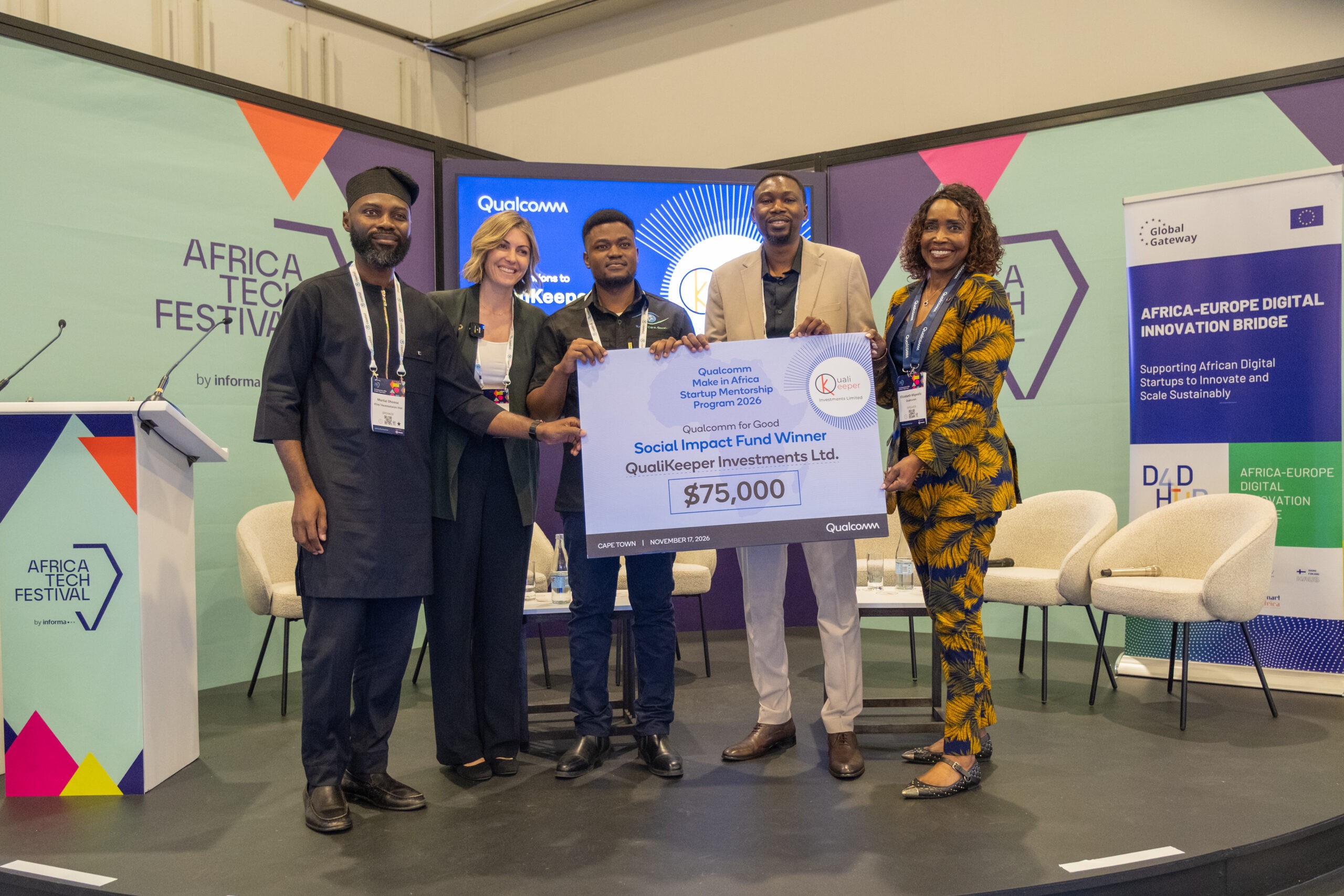
Zambia's Qualikeeper Investments Ltd has won the 2026 Qualcomm for Good Social Impact Fund, taking home an equity-free grant of US$75,000 to scale a livestock health monitoring platform built on affordable artificial intelligence and Internet of Things technology.
The award was announced on 17 November in Cape Town at the close of the fourth annual Qualcomm Make in Africa Startup Mentorship Programme, the first edition to end with an in-person finale, held during the Africa Tech Festival. The programme brought together ten early-stage startups from nine African countries working on solutions in agriculture, fish-farming, electric mobility, water purification and accessibility, according to New Era Live.
What Qualikeeper's StocKeeper platform does
Qualikeeper's StocKeeper platform uses low-cost AIoT tools to monitor livestock health, targeting farmers in resource-constrained communities where veterinary services and monitoring infrastructure are scarce. Qualcomm said the award recognises African-developed technologies that can tackle persistent development challenges while generating measurable social and economic gains.
Erica Ciaraldi, Manager of Government Affairs at Qualcomm Incorporated, said the Zambian company stood out for its practical focus.
"Qualikeeper was selected in recognition of its vision, ingenuity and dedication to strengthening animal health and farmer livelihoods among livestock-dependent communities in resource constrained environments," Ciaraldi said.
She added that Qualcomm wants to see the platform reach additional communities and extend its impact beyond Africa.
From prototype to market: the real hurdle for African startups
The grant is only part of the package. Each of the ten participating startups receives business coaching, engineering assistance, intellectual property guidance, a US$5,000 stipend and up to US$5,000 toward one full utility patent application. They also worked directly with Qualcomm technologies and Arduino development platforms, including the Arduino UNO Q.
That support matters because promising African technology concepts frequently stall at the prototype stage, blocked by limited financing, thin technical resources and restricted access to commercial markets. Turning an invention into a defensible, sellable product requires patent protection and engineering depth that most early-stage founders on the continent cannot finance alone.
Wassim Chourbaji, Senior Vice President and President of Europe, Middle East and Africa at Qualcomm France, said the programme is designed to close that gap.
"By providing access to Qualcomm technologies, Arduino's development platforms, mentorship, and ecosystem support, we help founders transform bold ideas into scalable embodied AI solutions that deliver real-world impact in a cost- and energy-efficient manner," Chourbaji said.
Qualcomm Vice President of Engineering Sudeepto Roy noted that the ten startups showed how machine learning and edge computing can be applied to practical problems across industries, while building a working understanding of intellectual property and the road from invention to commercialisation.
Why this matters for Namibia
Applications for the 2027 edition are now open, and Qualcomm has explicitly encouraged Namibian startups to apply with solutions built on Qualcomm and Arduino platforms. For Namibian founders, the programme offers three things the local ecosystem struggles to supply at scale: international engineering expertise, intellectual property support and commercialisation networks.
The fit with Namibia's economy is direct. The sectors highlighted by this year's cohort map onto national priorities: agriculture and livestock management in a country where farming anchors rural livelihoods, water purification in one of the driest climates in southern Africa, and electric mobility in a market exploring green transport options.
Namibian participation would also align with broader continental policy. The African Telecommunications Union, which supported the programme, linked the startups' work to the 2026 Abuja Declaration on Meaningful Connectivity for Africa, through which member states reaffirmed commitments to accelerate digital inclusion and expand participation in the digital economy.
"The innovators selected for this year's Qualcomm Make in Africa cohort demonstrate how this vision can be translated into tangible impact, harnessing artificial intelligence, advanced connectivity and other emerging technologies to develop locally relevant solutions that address real-world challenges and improve lives across African communities," said Martial Dhossa, Deputy Director of Radiocommunications at the African Telecommunications Union, as quoted by the Business and Financial Times.
A model worth watching
The Make in Africa programme's structure, equity-free capital combined with patent funding and hands-on engineering support, offers a template for how development finance can reach technology founders without diluting their ownership. TechAfrica News reported that the $75,000 grant to Qualikeeper signals growing investor confidence in African agritech, a sector where livestock losses from preventable disease remain a measurable drag on rural incomes.
For a liberalising, trade-open Namibian economy looking to diversify beyond commodities, programmes of this type represent a low-cost route into global value chains: local intellectual property, developed locally, owned locally, and sold internationally.
FAQ
Who won the 2026 Qualcomm for Good Social Impact Fund?
Qualikeeper Investments Ltd of Zambia won the fund, receiving a US$75,000 equity-free grant plus technical support for its StocKeeper livestock intelligence platform.
When and where did the Qualcomm Make in Africa finale take place?
The fourth annual programme concluded on 17 November 2026 in Cape Town, South Africa, during the Africa Tech Festival, in its first in-person finale.
Can Namibian startups apply for the 2027 programme?
Yes. Applications for the 2027 Qualcomm Make in Africa Startup Mentorship Programme are open, and Qualcomm has encouraged Namibian entrepreneurs to apply with solutions built on Qualcomm and Arduino technologies.
What support do participating startups receive?
Each startup gets business coaching, engineering assistance, intellectual property guidance, a US$5,000 stipend and up to US$5,000 toward one full utility patent application.