
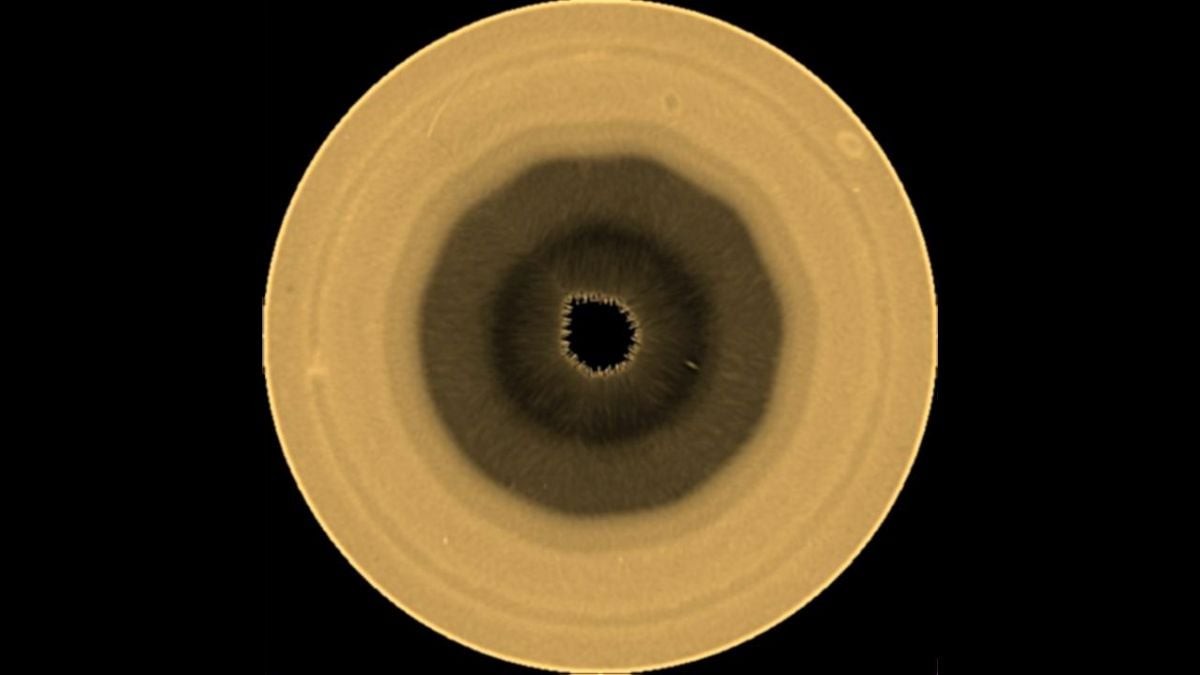
Astronomers have discovered a second giant polygon in Saturn's atmosphere, this time a ten-sided structure swirling around the planet's south pole. The finding, published in Science Advances, suggests that the gas giant's famous six-sided north polar hexagon is not a one-off cosmic quirk but part of a broader atmospheric pattern.
The discovery was led by Agustín Sánchez-Lavega of the University of the Basque Country in Spain. The team identified the decagon using images from amateur astronomers and confirmed it with high-resolution data from the Hubble Space Telescope, tracing its existence back to 2023.
What is the new decagon on Saturn?
The decagon is a vast atmospheric wave centered around 60 degrees south latitude. It rides on one of Saturn's powerful eastward jet streams, which races around the planet at roughly 420 kilometers per hour. The wave itself moves at a comparatively leisurely 10 kilometers per hour.
Observations at different wavelengths revealed traces of the decagon's shape at various altitudes and latitudes, indicating a vertically layered structure embedded deep in the atmosphere, similar to the northern hexagon.
How does the decagon compare to Saturn's hexagon?
The hexagon, first spotted by the Voyager probes in 1980 and 1981, has remained stable for at least 44 years. The decagon, by contrast, is a relative newcomer. It sits at a less polar latitude than its northern counterpart and appears less robust.
“In addition to the difference in the number of sides, the decagon is situated at a less polar latitude than the hexagon in the southern hemisphere, and is perhaps not as robust, as we have seen that it has formed,” Sánchez-Lavega explained.
The two structures are not mirror images. The hexagon has persisted for decades; the decagon formed only recently, raising questions about the conditions that govern their creation and stability.
What could be causing Saturn's ten-sided storm?
One plausible suspect is a high-pressure vortex, or anticyclone, located just north of the decagon. This roughly 4,000-kilometer-wide storm, which the researchers call a Red Spot, is a smaller analog of Jupiter's famous tempest. The decagon appears most pronounced near the vortex and least distinct on the opposite side of the planet.
However, computer simulations testing whether the storm could drive the wave's formation failed to reproduce the observed decagon exactly. Sánchez-Lavega noted that a similar vortex was present when the hexagon was discovered in 1980, but it later disappeared while the hexagon remained.
Why is this discovery important for planetary science?
The finding challenges the assumption that Saturn's hexagonal feature is unique. It suggests that polygonal waves can form in both hemispheres under the right atmospheric conditions, offering a natural laboratory for studying fluid dynamics on a planetary scale.
“This discovery suggests that the hexagon is not as extraordinary as previously thought and that, in fact, the conditions in Saturn's atmosphere are such that polygonal waves can form in both hemispheres surrounding the polar regions,” Sánchez-Lavega told ScienceAlert.
What happens next with the decagon?
Saturn's southern hemisphere is moving from spring toward summer, tilting increasingly toward the Sun over the planet's 29.5-year orbit. The increase in solar radiation could alter the decagon's behavior, and astronomers will have a better vantage point as the south pole tilts further into view.
“We need to understand how the decagon evolves, in other words, whether in the coming years it will become unstable and break up, or, conversely, become more stable and robust as solar radiation increases,” Sánchez-Lavega said.
Unlike the hexagon, which was discovered long after it formed, the decagon gives scientists a rare opportunity to watch a planetary polygon develop in real time. The research team will continue monitoring the structure to see whether it persists, strengthens, or dissipates.
Frequently asked questions about Saturn's decagon
How many sides does the new Saturn polygon have?
The newly discovered polygon at Saturn's south pole has ten sides, making it a decagon. It was confirmed in 2025 from images taken by amateur astronomers and the Hubble Space Telescope.
When was the decagon on Saturn first observed?
The decagon was first visible as a dark, undulating line in amateur images from 2024. Follow-up analysis traced its existence back to 2023 using Hubble data.
Is the decagon related to Saturn's hexagon?
Both are atmospheric wave phenomena, but they are not mirror images. The decagon has more sides, sits at a different latitude, and appears less stable than the northern hexagon.
Could the decagon disappear?
Yes. The decagon is less robust than the hexagon and may break up as solar radiation increases in the southern hemisphere. Ongoing observations will determine its fate.